Showing posts with label Hornet's Nest. Show all posts

Saturday, February 18, 2023

12. Valerio Colombaioni was Arturo


ARTURO (Valerio Colombaioni) is another boy who is very easy to identify.  He is small and wiry and dressed in a dark blue V-neck sweater and baggy black pants, his black hair falling in waves over his forehead.  He has a hard little face, nut-brown skin, and intense dark grey eyes that echo the colour of his sweater.  His overall aura is of toughness and deadly efficiency.

He is one of the demolition swimmers. In a shot just before the team begin their descent of the cliff, you see him, along with the bigger Umberto (Gaetano Danaro) manually ripping German uniforms into pieces that will protect their hands from rope burns. The ease with which he does this attests to his amazing physical strength. As they install the plastique explosives, Arturo is the boy highest up on the dam and directly below Turner (Rock Hudson), which means he is the last boy down, skittering the final suspenseful meters before making a clean dive into the water as searchlights rake the darkness above him. At this moment when I saw the film in 1980, the girls in the audience let out a collective “Eeeek!!” By that point it seemed everyone was invested in silent, diminutive Arturo.

Arturo is one of the rooftop gunners in the Reanoto vengeance massacre. As he and Aldo and two other boys prepare to climb up a tiled rooftop, he hunkers down in wait by some bales of hay, and at Aldo’s signal, turns to scuttle up a tree, moving with utter confidence, like a cat or a squirrel. Though in this sequence he crouches in the same position as the two other boys as he fires his weapon, there is considerably more drama in the tense lines of his body. Then, running to the army truck in triumph, mouth wide open in a yell of delight, he leaps over rubble without even looking at the ground.  A few moments later he is kneeling by the tailgate of the truck as it roars away, hanging onto the frame above with one relaxed hand, laughing and impervious to danger.

He is a lookout, perched high in a treetop. In the scene where the boys are having their rudimentary breakfast, you notice Arturo rappelling down his tree to silently join the group, as the small boy Romeo leaps up to take his post. And he, Romeo and another boy, Mikko, form the pyramid at the beginning of the film, utilizing their acrobatic skills to distract the German soldiers as their comrades recover the unconscious Captain Turner. In every scene he is in, he acts with his physique: notice the movement of his shoulders when Turner thunders at the boys to shut up their whistling, and his body bends into interesting angles as he sits or reclines.

***

To see the whole blog, click here: https://hornetsnest1970.blogspot.com/


Valerio Colombaioni, 14 years old in 1969 when Hornet’s Nest was filmed, was already a professional circus performer, having made his debut at age six, as a clown. According to another cast member, he and his cousins Ronald (Mikko) and Giancarlo (Romeo) were acrobats as well. He is not cute in the child-like sense, unlike the other actors who use voice and facial expressions to appeal to the audience. He seems to be in a world of his own, as though unaware of being filmed, hinting at the intense concentration a physical performance requires. You never know what Arturo is thinking, but he commands respect.

Valerio grew up to be handsome. He continued to work in circuses, and appears to have retained his childhood professional name, Ercolino, throughout his life. (Google tells me that this Italian word means a child who is robust or sturdy). He also appeared in films:  L'arciere di fuoco (Long Live Robin Hood), 1971, Squadra antifurto, 1976; Roma a mano armata, 1976; La Banda del Gobbo, 1977. He was a stunt performer in Cemetery Man (1994) and Pinocchio (2002).

With several members of his family, he appeared in Federico Fellini's I Clowns(1970). This documentary, or mockumentary, was made for Italian television and opened in the same month (December 1970) as Hornet's Nest/ Il Vespaio. 


Could the little hammer-wielding clown at the end sequence of I Clowns (1970) be Valerio?

Valerio appears on the poster of Sempre Piu Difficile


The Tom d'Angremond documentary Sempre più difficile (1981), with Dario Fo, explores the world of the small Italian family circus, focusing on the Colombaioni family – Valerio, father Nani and uncles Willy and Carlo among them. (This film is impossible to find on-line: if anyone knows of a copy, or even snippets of it, please get in touch.) 

"Valerio" seems to be a name he used for his film appearances. In his current work and social media profiles, he goes by the name Leris Colombaioni.  

In 1988, he had a significant role in the gorgeous La Maschera, 1988, with Helena Bonham Carter and Michael Maloney, appearing as a performer in a small travelling circus along with family members Nani, Walter and Saskia. This film, shot in Italian and with the parts of the English-speaking cast dubbed in, is incredibly hard to find: I've had to make do with screenshots from a Youtube channel. I recall seeing La Maschera in full at a friend's house in the early 2000s and wondering who that handsome Italian actor who'd played Iris's admirer was, and wishing the circus folk had had more screen time.

Valerio and Nani Colombaioni in La Maschera, 1988

As Ercolino, with Iris (Helena Bonham-Carter) in La Maschera


In Hornet's Nest / Il Vespaio, Arturo’s role is pretty much as it is in the original screenplay. Here is his first named appearance in the Michael Avallone novelization (1971):

“In the treetop above the locale of the cave, a boy named Arturo, aged eight, saw the procession coming. He immediately put his fingers to his lips and imitated the song of a bird. 

Down below the children were playing out front at the mouth of the cave. … They scattered at the bird call and look down the line to the trees. They saw Aldo coming, with Giorgio and Silvio flanking a tall, golden-haired woman. 

A fire was in progress at the cave’s entrance. Some of the children were bringing in water, others carried wood. Arturo’s whistle sounded again.”

The main difference between the movie and the screenplay Arturo is their age. The screenplay Arturo, as a consequence of his youth, does annoyingly cute things, like letting go of a railing on the dam  -- Look Ma, no hands! – to impress Turner; an unnecessary detail that would have detracted from the suspense of the dam-climbing sequence. Prior to the events of Hornet's Nest, young Arturo was supposed to have scaled the Della Norte dam from base to top, just for the heck of it, though this does not come out in the film.

*** 
1980 onwards: Valerio/Arturo left quite an impression on me. I painted my childhood avatar, also called Bing, wearing his outfit. I couldn’t imitate any of his physicality, so in consolation, as soon as I was out of school uniform and far from the critical eyes of my mother and sister, I began to buy clothes like his.  Over the years, I’ve owned a succession of dark blue V-neck sweaters, sometimes bought from the men’s wear section, worn with dark pants and leather shoes or boots. They give me a feeling of power.

***

Text by Lakambini Sitoy, copyright 2023
Screenshots from Hornet's Nest (United Artists), 1970 and La Maschera (1988), screenshots from Youtube.
Solo portrait of Valerio Colombaioni probably by production photographer Claudio Patriarca
Image of Arturo from Hornet's Nest poster, in gouache, artist unknown.

To see the whole blog, click here: https://hornetsnest1970.blogspot.com/


Friday, January 27, 2023

11. Giancarlo Colombaioni was Romeo


ROMEO (Giancarlo Colombaioni) is the youngest and the smallest of the Reanoto orphans.  He and two others appear at the very start of the movie, utilizing their acrobatic skills to distract the German soldiers as their comrades recover the unconscious Captain Turner.  He is the topmost in this three-man formation, balancing on Arturo’s shoulders then pitching forward skillfully to land, roll and right himself in a couple of seconds. In this way the trio set the tone of toughness and precocity, at least when it comes to the boys.

He is the lookout seen in the background, cautiously making his way down a tree, as Turner emerges from the cave, blinking in the daylight, the morning after the rescue. In the truck scene, he’s on the right side of the vehicle, directly behind the cab (closest to the camera) and appears to be having a really good time with his weapon. He’s one of the six boys who distract the German soldiers atop the dam as the demolition team dispatch two guards sitting in a bunker of sandbags. 

Romeo doesn't speak. He can often be seen in close-up, his angelic features at odds with his tough, impassive expression. In one scene in the cave, he and Carlo (Mauro Gravina) are shown cradling submachine guns, embodying the film’s selling point of war-blighted innocence. In the group shots, he often stands next to his two cousins, but on occasion he is positioned next to Rock Hudson, and has a tendency to look wonderingly up at him, the film playing up the difference between his diminutive, albeit sturdy, form and that of the 6’6” Hollywood star.

***

In the Avallone novelization of the screenplay, Romeo was supposed to be 8 years old.

***

Giancarlo Colombaioni was 11 when the movie was filmed. He is cousins with Valerio and Ronald Colombaioni, the two other boys in the acrobat formation. They belong to a noted and very large circus family (the surname is unusual and apparently is not associated with anyone outside the clan) that counts the clowns Carlo and Alberto Colombaioni as well as Arnaldo (Nani) Colombaioni and the juggler Willy Colombaioni among its members. It is likely that Giancarlo was already performing professionally at his young age, perhaps as a clown or an acrobat. In a 1985 movie, Robinson Crusoe mercante di York, he has a role as a juggler. It appears he has performed in circuses all his life.

***

Text copyright 2023 by Lakambini Sitoy

Screenshots from Hornet's Nest, 1970, United Artists
Earlier: Action boys and English boys
Why Hornet's Nest? Why only now?

To see the whole blog, click here: https://hornetsnest1970.blogspot.com/


Putting the baby in "Baby Brigade": Giancarlo next to Mauro Gravina and John Fordyce


Wednesday, January 18, 2023

10. Action boys and English boys


THE THREE young actors Daniel Keller, Daniel Dempsey and Joseph Cassuto -- plus a fourth, the slender boy in a white shirt – form a group I think of as the “English boys”.  They are native English or bilingual Italian-English speakers who, from the anonymity of the “chorus”, help to drive the plot and to supply important information (such as the presence of enemy trucks or the location of the transmitter in Capt. Von Hecht’s office), which would be pointless to dramatize.  They “tell” rather than “show” – the opposite, incidentally, of the prose writer’s mandate. They support the main characters by questioning or reacting to them.  Tekko, Giorgio and Franco were prominent in the novelization and early drafts of the screenplay, and Keller, Dempsey and Cassuto were included in the list of main cast members accompanying the New York Times review of the film.  The four “English boys” don’t speak more than a handful of lines collectively, but the story would progress very differently without their parts in the dialogue. 

They do not speak with the shrill voices of childhood nor with the rumble of adolescence.  They are in between.  In the scenes where the boys chatter excitedly in English, it’s interesting that it’s higher voices rather than lower ones that are heard -- in keeping with the intention of the original script that the orphans would be ages 8 to 12.  

Indeed it seems that there are really only two or three voices blurring together to represent the rest.  There’s no real dialogue to this chatter but just single lines (“He’s gonna blow up the dam!”) excited cries and laughter and, once, tantalizingly, a few words spoken in an Italian intonation but too faint to make out.  The sound they make reminds me of the hubbub of crowd scenes – brusio, Dan Keller said they were called.  He added his voice to a few of them in his time as a child dubber in Rome.  I wonder, actually, if that isn’t just young Dan in the recording studio, being layered and layered over himself. 

Despite Hornet’s Nest being a movie set in Italy with actors that sound and look Italian (even the German soldiers), there is no Italian dialogue.  A stray “Bellissima!” does not count. The actual Italians among the boys are silent.  Two of the older ones do get to speak in English, though they still sound as if they’re speaking Italian, which to me is quite charming.  

Was it unfair that most of the Italian cast were seen but not heard?  I don’t think so. They get to act with their bodies, and Hornet’s Nest would not be the adventure fantasy that it is without them.  I think of them as the “action boys.” They get to scramble up trees and handle plastique and fire guns from rooftops, spent casings flying about their ears. Several were from Naples and could swim and had movie-making experience. Three were professional circus performers.☺

A mixed bag: British, American and Italian actors


Text © 2023 by Lakambini Sitoy

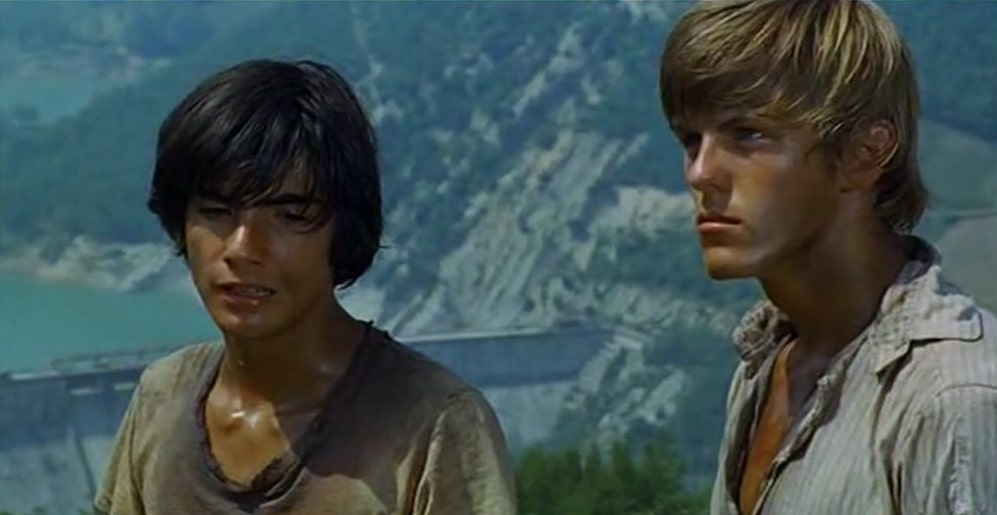
Screenshot from Hornet's Nest (1970), United Artists featuring characters Arturo, Luigi and Paolo.

B&W photo by Claudio Patriarca. Thanks to Dan Keller.


Earlier: Why Hornet's Nest? Why only now?

Soon: Valerio Colombaioni

Sunday, January 15, 2023

9. Joseph Cassuto was Franco


FRANCO is the first boy you see in the trailer, clad in a grimy white shirt and red shorts, dashing to the mouth of the cave to let Dino know that Aldo has arrived with the dottore. In the scene where the boys rescue Turner, he is the one who suggests to Aldo that the American may not want to help them in their revenge. (“Maybe he’ll say no, Aldo. Maybe he won’t want to.”) In the scene in the cave where the boys reveal the stash of weapons they keep in the niche, he’s the one on the right, picking up and passing the Schmeissers to the others. 


Dino names him as one of the boys whose father built the dam. He’s on the driver’s side of the truck as it barrels through Reanoto, by the tailgate.  He’s among the six who distract the German guards atop the dam by yelling and making provocative gestures, and appears to be the one who does a somersault in the water. He's a bit on the hyperactive side, leaping across the screen to help pin down Bianca and punching Aldo vigorously (and vertically). He resembles Carlo at first glance, but is bigger.

In the scenes where the group of boys mingle seemingly randomly, Franco can often be found next to Giorgio, Tekko and/or Tonio.

In the based-on-the-screenplay book by Michael Avallone, Franco is one of five demolition-team swimmers.

Cassuto, called Joseph in the New York Times review of the film but Giuseppe in the credits, was  likely the boy from Israel referred to in a 1969 article in The Forum, the student newspaper of Notre Dame International School in Rome. He lives in Israel today. 


*** 

To come: The "action boys"

To see the whole blog, click here: https://hornetsnest1970.blogspot.com/


Saturday, January 7, 2023

7. Daniel Keller was Tekko


THE two young boys stroll up the road towards the armed German sentries, their faces relaxed and guileless. As they reach the men, the boy in stripes says, "Hey, capitano, give us a sigaretta." The audience erupts in laughter. It's an experience that was universal for boys throughout the 60s and 70s -- cadging a smoke off mock-severe adults.

Nearly everyone who has seen or written about Hornet's Nest knows this boy as "Paolo". It's what Captain Turner called him:  "Paolo, Carlo, do your stuff".  It's a lovely name and it suits him and it goes perfectly with "Carlo." But this boy wasn't Paolo. He was Tekko.

Tekko is easy to spot throughout the movie. He has long straight brown hair and wears faded brown shorts, sneakers and that grubby striped t-shirt. He speaks his numerous lines in a high clear voice and an accent that is part American and part Italian, breaking in on the knot of boys around Turner to warn them of trucks across the river, and querying Aldo about his adventure with the girl in Venice. He's the kid who stumbles (or is shoved) while carrying a rucksack of dynamite, triggering a confrontation between Turner and Aldo and the erosion of Aldo's authority. In the truck scene, he's on the driver's side, between Giorgio and Franco. He's one of the six boys who strip down to their skivvies (or less) to splash around and taunt the guards atop the dam. He's in two of the movie posters as well.


Tekko enables things to happen, facilitating action or confrontation between main characters. Towards the end of the movie, the need to drive the plot through dialogue is lessened and he merges with the group.

In the first iteration of the screenplay (and the Avallone novelization), he is everywhere: He gets special mention in the would-be rape, redeems the boys the following morning by claiming that they wouldn’t have gone through with it, distracts the guards by swapping strawberries for cigarettes, drives the truck through Reanoto while Turner throws the hand grenades, and is a demolition swimmer. All that and he's twelve.  

***
1969: Tekko was played by Daniel Keller, a 14-year old American originally from New York. He'd celebrated his bar mitzvah the year before (the venue was the Great Synagogue in Rome) and was a student at the American Overseas School in Rome when he and some schoolmates were interviewed for a role in the film. The production, he told me, was looking for native speakers of American English. He'd had extensive work dubbing Italian movie lines into English for international release, though he says this was not related to his being cast.

Publicity shot of Daniel Keller by Claudio Patriarca, 1969

1980-81: I had a big crush on this boy when I was 11 and 12. I would draw him in my school notebooks and write stories featuring him (who I called "Paolo"). Part of the reason may have been his look -- with the straight hair and long oval face he stood out from the others. And part of it must have been that mischievous quality, that vitality. And the smile. In the close-ups, the gang look sad, or hard-eyed and dead serious, or they are laughing and jeering at the enemy. Tekko is the only boy who gets to smile.

I believed without question that the actor playing Tekko was Italian. My sister and I even gave him an appropriate name in our make-up world: Stefano Sigaretto. (We saw Hornet's Nest in a theater and didn't catch the names of anyone in the cast). Daniel's ancestors, however, can be traced to Ukraine, Poland and Romania. So he expanded the visual definition of "Italian" to my young mind. Nationality after all is not represented by mono-ethnicity, nor a single look.

*** 
I found Dan's website in late 2022, and to my great delight have been corresponding with him. Our emails can be found on the Il Vespaio page of his website: https://dan-keller.com/photos/1969-Vespaio/

*** 
Tekko is "Paolo" in the Spanish dub of the film as well.  Even Dan doesn't know how this happened: 
"(Rock Hudson) was probably reciting lines from a script that was on paper and not up to date. In those days, the word processor was a typewriter." (Email of December 30, D. Keller to L. Sitoy, on https://dan-keller.com/photos/1969-Vespaio/ )

See also: 

Below is a 1969 article in The Forum, the student newspaper of Notre Dame International School in Rome:


Text © 2023 by Lakambini Sitoy

Screenshots from Hornet's Nest, United Artists, 1970. Publicity headshot and scan of student paper article courtesy of D. Keller.


To come: Poppies, what a call sheet tells you

Wednesday, January 4, 2023

5. John Fordyce was Dino


DINO is the oldest and the tallest, blond-haired, blue-eyed and with a perpetual set to the jaw. It is as though he has to constantly restrain himself from throwing a punch at Aldo, with whom he frequently shares the screen. He is older brother to Mario and Maria and appears to have a close or familial connection with Giorgio (Daniel Dempsey) who is often (albeit unobtrusively) by his side. 

He is the cool-headed check to the mercurial Aldo. He is disgusted by the attempted rape and tells Aldo so, no doubt distancing himself from the role he played in it. He sabotages Aldo’s tale of the girl in Venice by referring to a fact they both know. The two boys appear to go a long way back; perhaps he is familiar with Aldo’s ticks and knows the leader’s tipping point, as well as his own.

He is not Aldo’s second in command. Their relationship is too complicated for that. Aldo speaks to him harshly (as he does to Luigi, Silvio, Tekko, Carlo and undoubtedly the rest) but never entrusts charge of the group to him. Aldo is annoyed when Dino receives a compliment from Turner for his scouting skills: it’s implied that Turner prefers to do business with the more mature and reliable teenager. Dino is Turner's choice for his second-in-command. 

Perhaps Dino knows Aldo too well to attempt to gain authority over the gang. They have guns, and Aldo has his loyal followers among the bigger boys. Dino, who has family that will need looking after, has a lot to lose should things go wrong. 


***

Here’s an excerpt of a New York Times article by Alfred Friendly Jr., dated Feb. 1, 1970 (“Mama Mia! Rome Is No Place to Be a Movie Star”):

… John Fordyce, on the other hand, seems to be making it. A 19‐year‐old American with a shag of blond hair, a gleam of even teeth, a lithe, athletic build and a minimal capacity for introspection, John has the advantage of having lived for years in Rome and of knowing the territory. He was “discovered” in 1967 at the chic, free‐form swimming pool of the Parco Dei Principi Hotel and sent off to Yugoslavia for a screen test and then the lead role in director Andrezej Wajda's “Gates of Paradise,” a still unreleased success at film festivals in Berlin and San Francisco.

John's next break came last year, as a result of his friendship with a chauffeur who often drives visiting film people. “I walked into the Colony Restaurant on the Via. Veneto, and my friend introduced me to the director he was driving that day and gave me a big build‐up as an actor.” He soon had a supporting role as the leader of a band of war orphans in a Rock Hudson‐Sylva Koscina movie called “The Hornet's Nest.”

John recently signed with the William Morris Agency and has four lines and fourth billing in a low‐budget Warner Brothers film called “Invasion,” which is being made at Cinecitta. On the set the other day he reflected, “I like fantasy. I always wanted to be Tarzan when I was a little boy. The best part in ‘The Hornet's Nest’ for me is where we kids get hold of machine guns and mow down about a thousand Germans.”

He is serious about being an actor, studies Stanislayski without yet understanding all of it and is a patient watcher of everything that goes on around him. About starting a film career in Italy, he is philosophical. “If they like your character here, you'll do fine, but it's not your talent that counts. That's where I'm lucky, because I was sort of brought up with these people. There are so many great actors here who can't get anywhere and a lot of bad ones doing really well. I haven't really had any experience, but here I am, working when others aren't.”

https://www.nytimes.com/1970/02/01/archives/mama-mia-rome-is-no-place-to-be-a-movie-star-rome-no-place-to-be-a.html


Saturday, December 31, 2022

1. Why Hornet's Nest? Why only now?


I first saw Hornet’s Nest in 1980, in a packed movie theatre in a small city in the Philippines.  It was the second time the film had played in Dumaguete; the first, according to an uncle, was in 1971 or so, and it was so popular back then people lined up just to get in.  We had no idea of the film’s many names, nor that Il Vespaio was the name originally given it in Italian and used during the filming.

I had just turned eleven when we saw the film; we had returned from a year in the States and were already very Americanized, not surprising that we had grown up on the campus of Silliman University, which had been founded by American missionaries in 1901. We spoke English, read only English books, and loved a good war flick -- there were lots of them from 10 and 20 years back, playing in the theaters.

My older sister and I fell in love with Hornet’s Nest, and we remembered all the scenes and all the lines. Everyone we knew had seen the movie, and the boys’ theme (composed by Ennio Morricone) was whistled in school corridors for months after that.

My sister and I had a shared fantasy world, and so we spent the next couple of years drawing and writing stories about the Hornet’s Nest boys, making them interact with other characters in that universe.

Because we never got all their names (much less the names of the actors who played them), we had to invent. And invent we did. We gave them new names and complete personalities, and in the process collapsed one boy into another and made two or three out of what had been one. Memory and imagination mixed.

Then as we got older, she and I fell out, and the old school notebooks and folders of drawings were put away and lay untouched for nearly 40 years.

I was at my childhood home in August this year, and finally called up the courage to open, first my box, and then my sister’s, with a view to photographing everything before it all crumbled to bits. So, filled with nostalgia, and sadness that many of the best notebooks were missing (my fault!) and that my sister was no longer around to help me remember our stories, I decided to re-immerse myself in that world once again.

The boys in this movie are virtually nameless. Ironic, because the end credits present us with a screenful of names: Franco and Tonio, Arturo and Mikko and Romeo, Silvio and Umberto... and so forth. But because few of them are ever called by name as the film progresses, the audiences never get to know who is who. By the 1970s, it was standard to designate a minor movie character with some descriptive phrase: "Bossman's accomplice" "Juggler" "Class child." But not so with Hornet's Nest. No "Lookout Boy", "Demolition Boy no. 2", "Boy who had to pee in front of the sentry." 

The list of first names was elegant and tantalizing -- it indicated that somewhere there had been a master plan where each boy, perhaps, had a back story, maybe even a character arc. 

At the very least, I wanted to match faces with names. My sister and I had had a whale of a time re-inventing the 15 teenagers of Captain Turner's Baby Brigade, but something was missing. I'd tried twice before, in 1989, when I found a VHS tape of the movie and made some awful color sketches of the boys, taking notes (no luck there) and again in 2012, when I purchased the Michael Avallone based-on-the-screenplay novel off E-bay (still no luck -- the familiar lines had been shuffled around so that attributed to two or three boys were lines spoken by just one in the film).

What was missing was the actors. I've never been the kind of person to watch a film without simultaneously imagining the production behind it. Today, I sit in front of the TV with a finger hovering over my device, and it's a rare movie that can compete with the IMDB. My older sister was the same, and we'd always been that way, so when the 15 Italian boys lost their luster (somewhat) we went on to invent the world of the film production, with results that are too ridiculous to go on the internet. Two smartass girls, 11 and 14... what do you expect?

So I decided to use a combination of social media and movie databases to match names to faces and try to find out who everyone had been and (hopefully) how they had come to be in Il Vespaio. If I ran a search for the names of the actors, focusing only on men in their late 60s with a connection to Italy, maybe I would recognize a face and be able to match it to one of the boys in the film. I’d recently done a portrait project where I’d had to compare photos of some people taken today with images of them from decades ago, and I figured I knew how to study a face and how it changes with the years. I wanted to write about them, and how important they had been for me as a child (or a young girl), how vital to the creative side of me. I decided I would not make it one of those awful "Where are they now?" features that both feed, and feed on, ageism. It was enough to know who they all had been. Details of how they'd come to be in the movie, and a hint or two of the trajectory of their lives since would be an extra reward.

Did I succeed? Yes. Did I contact them? Well, only one, as of this writing (but it feels like I hit the jackpot!). Social media feelers for a couple more.

*** 

This post began as an email, which was sent on November 30  via web contact form to Dan Keller, who played Tekko. How I sweated over what to write him.  The resulting email conversation can be read on his website at: https://www.dan-keller.com/photos/1969-Vespaio/    I’m pleased  to say that as a consequence  of our exchange, Dan found more and more photos from his files and posted them on his Il Vespaio page. I’ve gotten his permission to share those photos on-line. The behind-the-scenes photo above, also the background image of this blog, is courtesy of Dan, and was taken by production photographer Claudio Patriarca.


https://hornetsnest1970.blogspot.com/2022/12/blog-post.html

10. Action boys and English boys

  THE THREE young actors Daniel Keller, Daniel Dempsey and Joseph Cassuto -- plus a fourth, the slender boy in a white shirt – form a gro...